A clunk or knock from the front of a Tesla Model 3 over bumps is almost always worn front suspension, and the front upper control arms are the usual suspect. Tesla suspension repair is one of the most common jobs at SD Hybrids, our independent hybrid and EV shop on Morena Blvd in San Diego. We find the worn part, replace it, align the car and quote the price before any work starts.
Here’s what causes the noise, which parts fail, what a federal safety probe means for your car, and how to get it fixed without a long wait.
What a Model 3 Suspension Clunk Sounds Like
Most owners describe a single dull knock from the front when they roll over a speed bump, a driveway lip or a pothole. Some hear a creak when turning slowly in a parking lot. Others feel it through the steering wheel more than they hear it.
The Model 3 suspension clunk tends to start quietly and get louder over months. It usually shows up once the car has a few years and a lot of speed bumps behind it, and road quality and driving style speed it up or slow it down. The Model Y uses a closely related front suspension and shows the same pattern.
The Parts That Usually Cause It
A Tesla’s front end has several links that can wear. In our experience, these are the ones that cause most of the noise:
- Front upper control arms: the ball joints wear and develop play. This is the classic source of the clunk
- Front lower lateral links and compliance links: worn bushings cause knocks and vague steering
- Sway bar end links: a lighter rattle over small, uneven bumps
- Shock mounts: a thud on bigger hits
- Loose or under-torqued fasteners: less common, but quick to rule out on a lift
Tesla control arm replacement is usually done in pairs so both sides wear evenly. After any of these parts are replaced, the car needs an alignment. Skip it and you’ll chew through a set of expensive EV tires.
The Federal Investigation Every Model 3 and Model Y Owner Should Know About
In July 2026, the National Highway Traffic Safety Administration opened a preliminary evaluation into about 1.2 million 2018–2020 Model 3 and 2021–2023 Model Y vehicles. According to Electrek’s report on the NHTSA probe, the agency logged 156 complaints of the front lower lateral link separating while driving. NHTSA said it was not aware of any crashes or injuries tied to it.
A preliminary evaluation is not a recall.
Still, run your VIN through the NHTSA recall lookup every few months. If a recall is issued for your car, the fix is free at Tesla, and you should use it. If your car clunks today, don’t wait on a decision that could take a year. Get it inspected.
Signs You Shouldn’t Keep Driving On It
A light clunk over speed bumps is a reason to book an inspection. These are reasons to book it this week: the steering wheel sits off-center on a straight road, the car pulls to one side, the steering feels loose or wanders on the freeway, or the inside edges of the front tires are wearing faster than the outside.
Each of those points to play in the front suspension that’s affecting alignment. The longer it goes, the more tire tread you lose, and on a Tesla that adds up fast.
Is It Covered by Tesla’s Warranty?
Possibly. Tesla’s warranty page lists a Basic Vehicle Limited Warranty of 4 years or 50,000 miles, and suspension parts generally fall under that basic coverage rather than the 8-year battery and drive unit warranty.
If you’re inside 4 years and 50,000 miles, book with Tesla first. If you’re past it, you’re paying either way, and the question becomes who can get you in sooner with a fair price. That’s where independent Tesla suspension repair makes sense. For the full rundown on warranty rights, read our guide to independent Tesla repair in San Diego.
How We Diagnose and Fix It
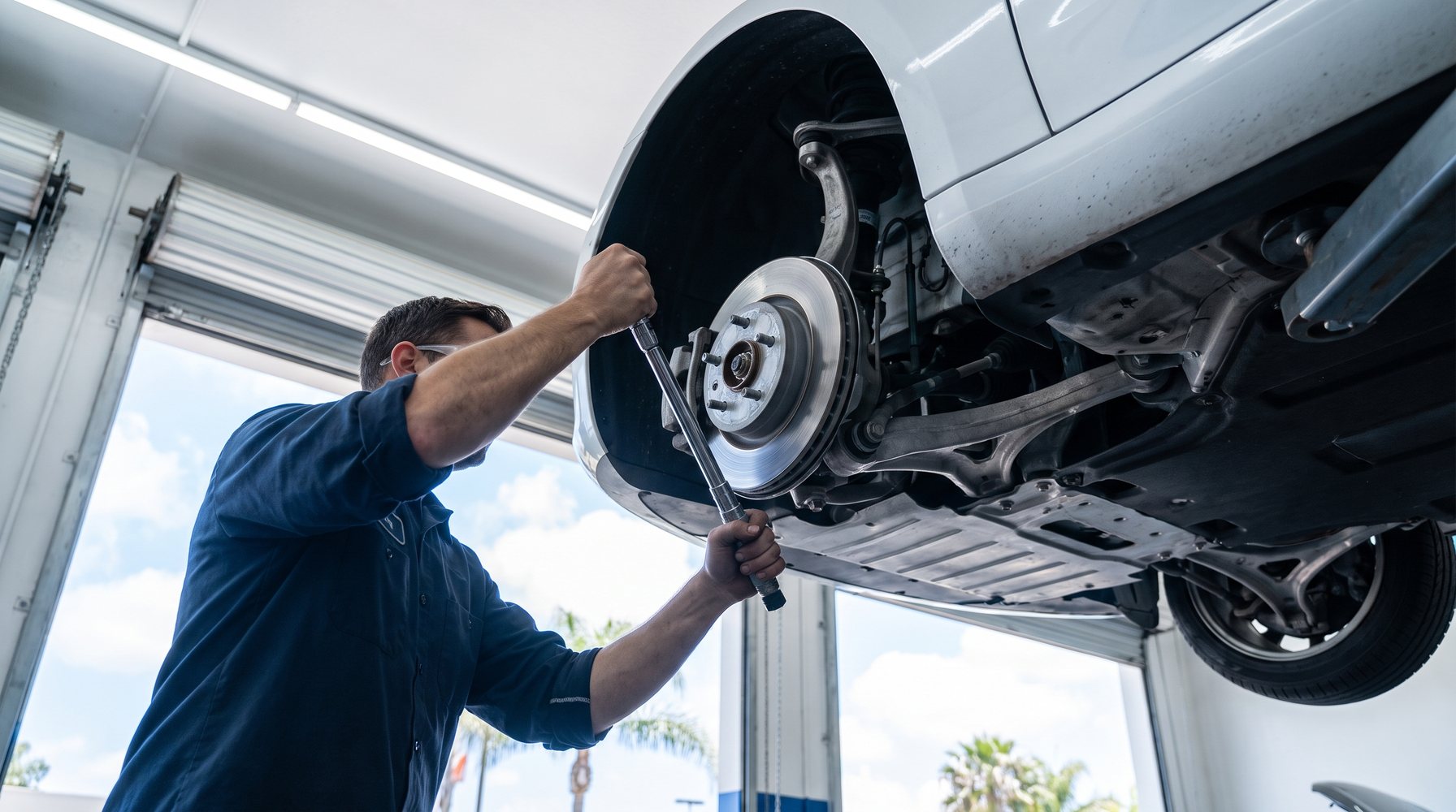
We start with a road test over the same kind of bumps that make your car clunk. Then the car goes on a lift using Tesla’s specified lift points, and we check each ball joint and bushing for play with a pry bar and by hand.
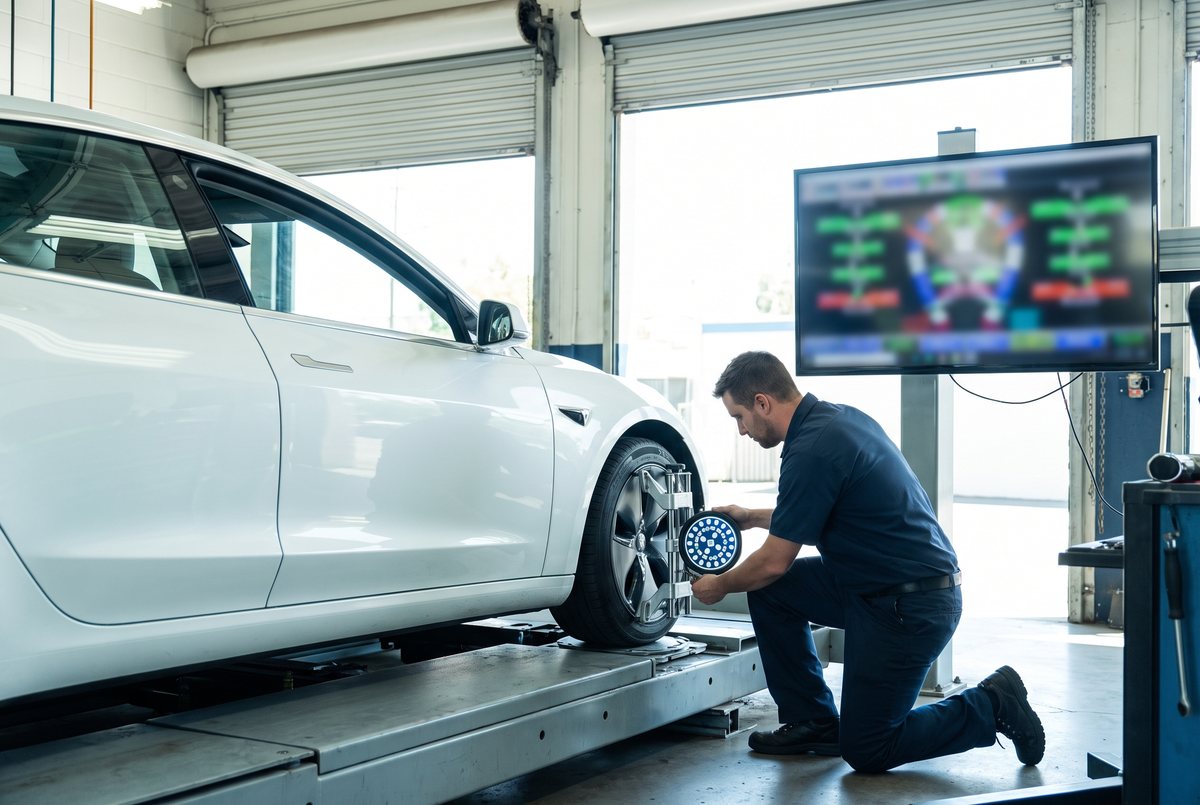
Once we find the worn parts, you get a written quote for the parts, labor and alignment before anything comes off the car. Most Tesla control arm replacement jobs are done in a day. We torque every fastener to factory spec with the suspension loaded, the same way the service manual calls for, then align the car and road test it again.
Want a price before you drive over? Request a Quote with your model, year, mileage and when the noise happens.
Why San Diego Roads Wear Tesla Suspensions Faster
A Tesla is heavy for its size because of the battery pack under the floor, and that weight loads the front ball joints on every bump. Add San Diego’s mix of patched freeways, steep hills and speed bumps, and those parts work hard.
Owners in hilly neighborhoods like Point Loma see wear sooner from constant climbing, braking and turning. The good news: none of this is a reason to worry about the car. It’s ordinary wear on a heavy vehicle, and it’s very fixable.
Frequently Asked Questions
Is it safe to drive a Tesla with a suspension clunk?
For a short time, usually. But worn ball joints and links get worse, and a separated link can make the car undriveable. If the steering feels loose or the car pulls, stop driving it and have it towed.
How long does Tesla suspension repair take?
Most front control arm and link jobs, plus the alignment, are done the same day. We’ll confirm parts availability when we quote.
Do you do Tesla alignments in San Diego?
Yes. Every suspension job includes an alignment, and we also align Teslas after tire replacement. See our repair and maintenance services for the rest of our general work.
Do you work on the Model Y, S and X too?
Yes. Our Tesla repair page lists the models and jobs we handle.
Ready to Get Started?
Clunk over bumps? Get your Model 3 or Model Y inspected by an independent EV team and get the price before any work starts, usually with same-day repair.
Request a Quote or call us at (858) 539-5404.